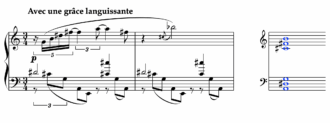
Simple integer ratios between frequencies (just intervals) have historically been invoked as the basis of musical harmony. Hugo Riemann’s theory of Tonvorstellung proposes that we mentally ‘represent’ pitches as members of justly tuned triads. Broadening the scope of Riemann’s theory to include more complex interval ratios, James Tenney argues that we understand heard intervals as approximations, within a tolerance range, of referential just intervals. This essay develops the idea of tone representation as an analytical tool for contemporary music. An excerpt from Gyo¨rgy Ligeti’s Melodien (1971) is analyzed as a succession of just intervals pivoting above a shifting fundamental. A close reading of the opening of Ge´rard Grisey’s Vortex Temporum (1994 – 1996) explores tone representations of complex microtonal harmonies, and examines the gap between compositional techniques and aural experience in this ‘spectral’ work.
Formal and Harmonic Coherence in Franz Liszt’s Ballade No. 2 in B Minor
Source(s) of analysis: Score Musical work: Ballade No. 2 in B minor S.171 Year of creation: 1853 Composer's name: Franz Liszt Methods of analysis: Conventional / Traditional analysis, Formal analysis, Other, Structural analysis
Target Group / Study LevelLevel of music analysis knowledge: Advanced, Intermediate
Study cycle: Bachelor, Master, PhD and professional
Read more